So you’re thinking about starting a blog, and you’re excited about the prospect of sharing your ideas and experiences with the world, and hopefully making some great money along the way.
Or maybe you’ve already set the wheels in motion and you’re ready to take the next steps. You’ve created some posts, you’ve got yourself a theme that you’re happy with, and you’re tentatively finding your feet with your new project.
But how do you make the leap between getting off the starting blocks, and turning your website into something that actually earns you an income?
Well, here’s the good news…
Blogging isn’t a get rich quick kind of thing, but if you get it right, it can be hugely profitable and even become a flourishing career that allows you to explore your passions whilst giving you the kind of lifestyle that you really crave.
In this post, I’m going to give you the full lowdown on exactly how you can make money blogging in 2019.
I’ll explain the monetisation methods that are working right now, the tools and tactics that make them possible, and I’ll even include real-life examples from down in the trenches, that you can model in your own blogging business.
Let’s get down to it…
MAKE MONEY BLOGGING WITH ON-PAGE ADVERTS
When it comes to how to make money blogging, using on-page adverts is probably one of the most well known methods.
There are two popular types of adverts that bloggers use:
- CPC/PPC ads: Cost-per-click (also known as pay-per-click) ads are displayed in your side bar or as a banner at top or bottom of your pages, and you’ll earn money every time a reader clicks on that advert
- CPM ads: Cost-per-mille ads are displayed in the exact same way to your readers, though they’re paid on a ‘cost per 1000 impressions’ basis. This means that you’re paid based on how many times those ads have been displayed to readers, regardless of whether they clicked through
The good news when it comes to ads is that it’s super easy to get started, and you could have them displayed on your blog in hardly any time at all.
You’ll be pleased to hear that you don’t have to track down advertisers yourself – you can sign up for free to a programme like Media.net, and by adding a simple piece of code to your blog, they’ll serve adverts that are relevant to your readers.
Exactly how much you’ll earn is difficult to say, as there are tons of variables to consider. Your niche, your location, the number of ads that you’re happy to display per page, and how many pages your readers typically visit per session are all going to have an impact.
The bottom line though when it comes to on-page adverts is that unless you’re running a big name blog with masses and masses of traffic, they’re never going to make you rich.
As a general yardstick, expect to earn around £2 per 1000 visitors. If you’re mentally doing the maths right now, you might be feeling a bit disappointed – but for small to medium bloggers, your earnings are likely to comfortably cover the costs of running your site.
Traffic really is key here though, and if you’re smashing it in this regard, it’s well worth applying to join Media Vine. You need to have 25,000 sessions per month on your site to be considered, but they’re widely regarded as being the cream of the crop when it comes to on-page adverts for bloggers, and pay significantly higher than other networks.
This definitely proved to be true for Spencer Haws from Niche Pursuits. By switching to Media Vine, he increased his daily ad earnings to an average of $45 – an 80% increase on previous performance:

Of course, not everyone agrees that using adverts is a wise monetisation strategy. Some bloggers feel like they ruin their readers’ experience, that they’re intrusive, and that they’re really not worth the money that you’re likely to earn.
Ultimately, it’s your decision to make, and like anything in the world of blogging, there are pros and cons to consider.
MAKE MONEY BLOGGING WITH AFFILIATE MARKETING
Another way to make money blogging is by including affiliate links in your content. This is how affiliate marketing works…
- A company has a product or a service that they want to sell. They offer to give you a commission for every sale that you send their way, at no extra cost to the buyer
- You’re provided with a unique link that has a tracking code attached to it. This means that when someone makes a purchase after clicking your link, it’s automatically tracked
- You include this link in your content – for example, you could write a review of the product or service, or you could create your own banner advert to display on your site, or you could share it on social media – and you get paid for every sale that you send their way
Affiliate marketing is, hands down, my favourite monetisation strategy. It allows me to get paid for waxing lyrical about companies that I’m passionate about and that I’d happily recommend for free, and unlike on-page adverts, it can work for you even if you have a relatively teeny-tiny audience.
Whereas volume of traffic is what matters with on-page adverts, success with affiliate marketing ultimately comes down to being a trusted voice for your followers, having integrity, and carefully selecting affiliate partners that are a great fit for your readership.
As a money blogger, if I were to suddenly start stuffing in affiliate links for a skirt I’d recently seen in Topshop, it would make absolutely no sense whatsoever. My readers would be confused. I’d be risking any gravitas that I’d built up as a trusted voice in my own field. As well, it would be unlikely to convert into sales. People don’t read my stuff for fashion advice, so there’d be a huge disconnect.
A great starting point is to consider the products and services that you already use yourself, and that you know would be useful for your audience, for the very reason that they come to you for.
Many companies have details of their affiliate programmes on their websites with information on how to apply. Another great resource to check out is Awin – it’s a network that gives you access to 13,000+ advertisers, including a ton of big name brands.
Though the beauty of this way to make money blogging is that you can start out small, it also has the potential to grow into something huge.
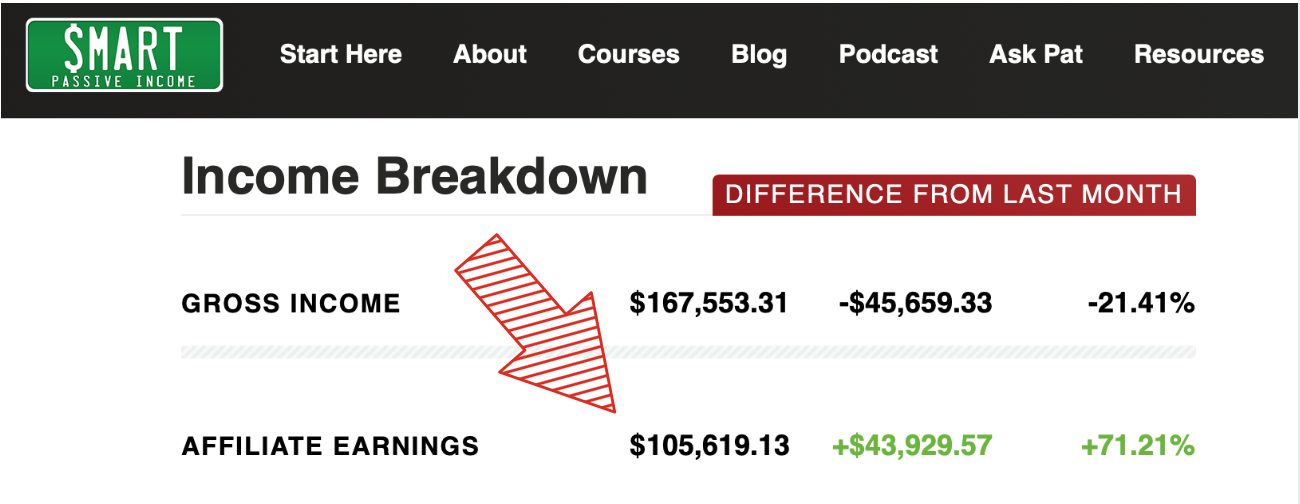
Take a look at this income report from Pat Flynn over at Smart Passive Income, who earned a whopping $105,619.13 from affiliate marketing in just ONE MONTH, in December 2017.
Now, listen…
I’m the first to hold up my hands here and tell you that this is an extreme example from a powerhouse blogger, who has been in this game for many years.
Pat’s also based in the US, and so it’s not strictly fair to use his earnings as a benchmark for what’s realistic here in the UK. We’ve got a tiny population in comparison, for one thing.
But I’ve included this because I want you to see that blogging can be what you want it to be. It can be a side hustle that pays for a holiday here and there, or it can be a seriously profitable business in its own right, with the power to literally change your life.
The potential of affiliate marketing certainly isn’t to be sniffed at if you want to make money blogging.
MAKE MONEY BLOGGING WITH SPONSORED CONTENT
As you build up a reputation in your niche as being an authority, and as someone who readers can really trust to create valuable content, it’ll often be the case that brands will reach out to you to propose paid partnerships.
Equally, many bloggers will actively reach out to businesses they want to work with, and offer these kinds of collaborations.
It’s a mutually beneficial arrangement – the brand gets exposure to your audience, and you’re paid in exchange for creating and sharing the content.
In practice and in the simplest of terms, sponsored content could include creating a blog post, an Instagram post, an Instagram Story, or a Tweet discussing the brand and what it has to offer for your audience.
The best sponsored content doesn’t read like an advertisement (even though you’re both legally and ethically obliged to disclose it as such), but is genuinely useful for your readers and is in line with your blogging brand.
Wondering how much bloggers charge for this kind of thing? Again, there are a range of factors to take into consideration, from the niche you operate in to the amount of views that you have on your blog each month. For a deeper dive into typical fees, check out this post from Jenna at The Bloglancer on how much you should charge for sponsored posts.
As is the case with affiliate marketing, integrity is key here. If you’re working with any old brand that’ll have you, then it’s not going to do you much good in terms of a long term, profitable career in blogging.
On the other hand, if you’re selective about who you work with and you deliver quality work and results, you’re putting yourself in a great position for being in-demand by the brands you want to work with, whilst continuing to build your authority with your readership.
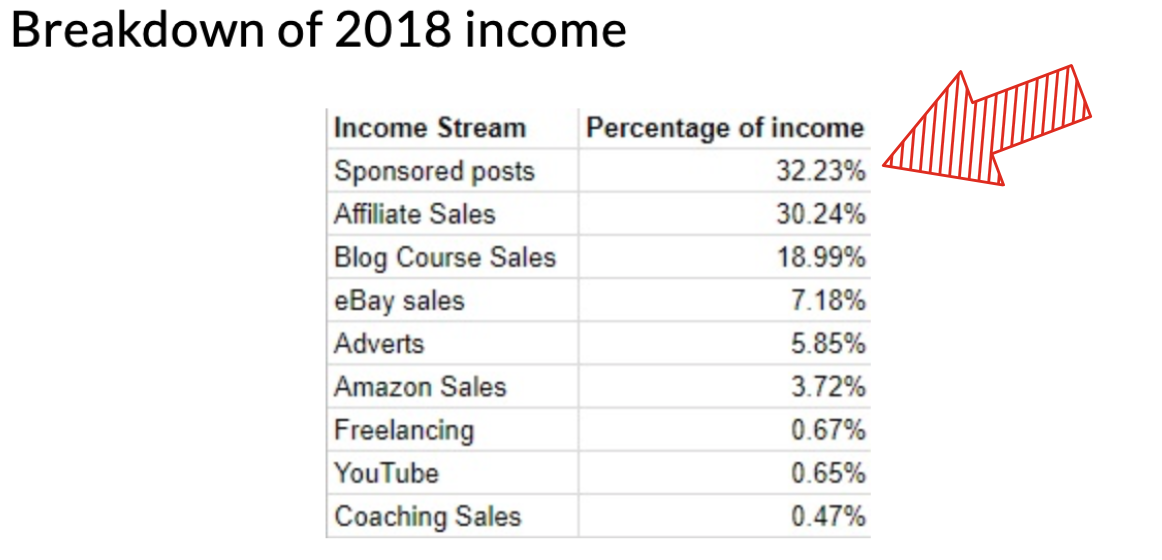
My fellow UK money blogger Emma Drew earned over £100,000 in 2018, and she shared that more than 30% of that was via sponsored posts…
MAKE MONEY BLOGGING BY SELLING LINKS
Okay, so this one is pretty controversial in the blogging world and is the black sheep of the monetisation family, and I’ll explain why in a minute.
But first of all, let’s consider the background and what it’s all about…
Search engine optimisation (SEO) is the practice of improving a website’s ranking in search results pages. So if you have a business selling gym leggings, for example, then making sure that your website ranks high on the first page of Google (and indeed other search engines) when people search for ‘gym leggings’ has the potential to make you a ton of sales.
It quite simply means that more people are going to see your products when they’re searching for them, and that can translate into a huge boost in your profits. As such, there are agencies and individuals all around the world that offer services that improve websites’ rankings in search.
One of the factors that’s known to improve these rankings is building links from other websites. The idea being that this indicates to search engines that it’s a quality site, that others are talking about and linking to, thanks to its excellent content.
And so one activity that many SEO practitioners will carry out is buying links from bloggers back to their clients’ sites, in the form of dedicated blog posts, or sometimes as a banner ad. Though it’s a similar premise to brands that are looking for sponsored content, these SEO guys are typically looking for one thing only – a link that’s known as a ‘do follow’ link.
How’s this different to the sponsored content that we mentioned above?
Well, if a brand genuinely wants exposure to your audience, they’ll usually be happy for you to add a little bit of code to your link that deems it as a ‘no follow’ link. This indicates to Google that a monetary exchange has taken place, and so it’s not a natural link placement. You’ve followed their guidelines, and you’ve stayed on the right side of them.
Because, you see, Google frowns upon the practice of buying links. They view it as a way to manipulate their algorithms, and if they suspect that you’re selling links, you’re risking having your site slapped with a penalty. This means that you could find that your own organic traffic takes a nosedive, or even disappears completely – and if you rely on this kind of traffic, that’s potentially a real risk to your other monetisation strategies.
So whilst selling links in this manner has the potential to be extremely profitable – I’ve known of bloggers selling links for up to £500 a shot, and it’s a job that can be done and dusted in less than half an hour – it’s not without its risks.
As always, you need to consider too whether this kind of practice is going to jeopardise your authority and the relationship that you’ve built with your readers. If you’re usually blogging about personal finance and you champion great money management, but then you suddenly publish a post plugging a payday loans company, then there’s an obvious issue there.
We all have own circumstances. We’ve all got bills to pay. At the end of the day, this definitely isn’t illegal, and the world won’t end if you sell a few links here and there if you want to make money blogging.
And sometimes, there may be offers that come your way that allow you to sell posts with links to companies that are indeed in line with your blog’s message and your personal beliefs and values.
Ultimately, it’s your own decision to make as to whether you’re happy to add this to your monetisation toolkit. It’s just a case of having your eyes open to the situation and knowing the pros, the cons, and the implications!
MAKE MONEY BLOGGING BY SELLING YOUR OWN DIGITAL PRODUCTS
Once you’ve been blogging a little while and you’ve built an audience, you may want to consider creating digital products for readers who want to work with you a little more closely.
These include, but aren’t limited to:
- Online courses/workshops
- Online coaching/mentoring
- E-books
- Printables/checklists
There’s only so much information that you can realistically include in a blog post, regardless of how detailed your content might be, so this gives you the option to further monetise your knowledge whilst delivering more detail and accountability.
There are a few main benefits to this…
First of all, being a blogger with your own product (providing it’s a quality product that’s well worth the investment, of course) is a sure-fire way to ramp up your authority and cement your positioning as THE go-to blogger in your niche.
As well, you’ll have complete control over your product. As an affiliate, you are bound to someone else’s pricing and processes, but when you create your own, you’re completely in the driving seat.
And finally, of course, a digital product done well can be hugely profitable. Though it’s important to not underestimate the amount of work that will go into its creation and promotion, the profits are entirely your own to keep, and you can scale it as much as you desire.
In fact, Michelle Schroeder-Gardner from Making Sense of Cents earned over $1,000,000 over two and a half years from her first online course.

Shameless plug… I’ve created my own digital product! It’s called Your Wildly Profitable Sales Page, and I show bloggers and freelance writers how to write sales pages that make a ton of sales.
MAKE MONEY BLOGGING BY SELLING YOUR OWN SERVICES
When you start a blog, you instantly have a portfolio that showcases your writing. If you have dreams of becoming a freelance writer, a blog can be a great way to attract new clients and get paid to write.
Equally, a blog can be a great platform to launch services including photography, design, coaching, and consulting.
Selling services from your blog may feel slightly less glamorous than some of the more passive income opportunities, but it’s something that you can break into fairly quickly in your blogging career. If you’ve got an expertise that you’re proud of and that you want to explore further, this one is definitely something to consider.
Getting started is super simple. You can create a page on your blog to let people know about the services you offer, and add a ‘contact me’ form.
SO CAN YOU REALLY MAKE BLOGGING?
In a nutshell, yes.
There are tons of examples right here of real people who are consistently earning fantastic money from blogging.
But as is the case with any kind of entrepreneurial pursuit, the success stories are the exception rather than the norm. So many blogs are started with the best intentions, but end up being abandoned before they’ve ever earned a single penny.
Why?
Because people lose interest and they throw in the towel. They realise that it’s hard work, that there’s a load of stuff to learn, and they aren’t prepared to ride out the learning curve and treat it like a real business which needs to be nurtured and tweaked and developed over time.
But if you’re serious about blogging, and you’re willing to be consistent and make a commitment for the longer term?
Then blogging can be absolutely anything that you want it to be. It can be a side hustle that creates a bit of extra cash each month, or it can even be an extremely lucrative full-time career.
If you’ve got a passion for writing, and you have a desire to share your knowledge and help people who are just like you, then blogging could be just the thing that you’ve been looking for.

Wow Ruth, this is an incredible post, so comprehensive and really useful!
Thank you Clare!
Great list Ruth! 🙂
Thanks Francesca!
I love just how detailed this post is. It really spells things out clearly for a new blogger.
Thanks Joleisa!
Great post Ruth, very useful!
Thanks Fiona!
This was really informative thanks!
I’ve just relaunched my blog and I’m wanting to really get cracking with making money from it
Hi Alice, I’m so pleased you found it useful!
This is all very useful to me! Thank you so much for sharing!
This is a really helpful post, thank you for sharing the info.
Great blogging tips, it sure will come handy for me one of these days.
I always found affiliate marketing a bit hit and miss for my blog, but I think it’s probably because I don’t have a niche. I suspect it works better for those that do.